Table of Contents
The England Women vs South Africa Women rivalry has evolved from one-sided dominance on dusty 1960s Test pitches to a fierce, balanced battle packed with World Cup heartbreak, T20 fireworks, and seismic power shifts. What began as quiet respect has exploded into high-stakes drama, aggression, and unforgettable moments that keep fans hooked across formats.
Recent Match
England Women’s National Cricket Team Vs South Africa Women’s National Cricket Team Timeline Encounters Across Formats (as of February 2026)
| Tournament | Venue | Date | Toss | England Score | South Africa Score | Result | Series | Player of the Match |
|---|---|---|---|---|---|---|---|---|
| ICC Women’s World Cup 2025 | Barsapara Cricket Stadium, Guwahati | Oct 29, 2025 | England (field) | 194/10 (42.3) | 319/7 (50) | South Africa won by 125 runs | ICC Women’s World Cup 2025 | Laura Wolvaardt (SA) |
| ICC Women’s World Cup 2025 | Barsapara Cricket Stadium, Guwahati | Oct 3, 2025 | England (field) | 73/0 (14.1) | 69/10 (20.4) | England won by 10 wkts | ICC Women’s World Cup 2025 | Linsey Smith (ENG) |
| Only Test | Mangaung Oval, Bloemfontein | Dec 15-17, 2024 | England (bat) | 395/9d (92) & 236/10 (74.1) | 281/10 (88.4) & 64/10 (19.4) | England won by 286 runs | England Women tour of South Africa 2024/25 | Lauren Bell (ENG) |
| 3rd ODI (D/N) | Senwes Park, Potchefstroom | Dec 11, 2024 | South Africa (bat) | 153/4 (19/23, tgt 152) | 233/8 (50) | England won by 6 wkts (DLS) | England Women tour of South Africa 2024/25 | Tammy Beaumont (ENG) |
| 2nd ODI | Kingsmead, Durban | Dec 8, 2024 | South Africa (bat) | N/A (chased adjusted target) | 135/10 (31.3) | England won by 6 wkts (24 balls rem) (DLS) | England Women tour of South Africa 2024/25 | N/A |
| 1st ODI (D/N) | Diamond Oval, Kimberley | Dec 4, 2024 | England (bat) | 186/10 (50) | 189/4 (38.2) | South Africa won by 6 wkts | England Women tour of South Africa 2024/25 | N/A |
| 3rd T20I | SuperSport Park, Centurion | Nov 30, 2024 | South Africa (bat) | 1/128 (11.3) | 124/10 (20) | England won by 9 wkts | England Women tour of South Africa 2024/25 | N/A |
| 2nd T20I | Willowmoore Park, Benoni | Nov 27, 2024 | England (bat) | 4/204 (20) | 6/168 (20) | England won by 36 runs | England Women tour of South Africa 2024/25 | N/A |
| 1st T20I | Buffalo Park, East London | Nov 24, 2024 | South Africa (bat) | 6/143 (19.2) | 5/142 (20) | England won by 4 wkts | England Women tour of South Africa 2024/25 | N/A |
| ICC Women’s T20 World Cup 2024 | Sharjah Cricket Stadium, Sharjah | Oct 7, 2024 | South Africa (bat) | 3/125 (19.2) | 6/124 (20) | England won by 7 wkts | ICC Women’s T20 World Cup 2024 | N/A |
| ICC Women’s T20 World Cup 2023 | Newlands, Cape Town | Feb 24, 2023 | England (bat) | 8/158 (20) | 4/164 (20) | South Africa won by 6 wkts | ICC Women’s T20 World Cup 2023 | N/A |
| Commonwealth Games Women’s Cricket Competition 2022 | Edgbaston, Birmingham | Aug 2, 2022 | England (bat) | 5/167 (20) | 4/141 (20) | England won by 26 runs | Commonwealth Games Women’s Cricket Competition 2022 | N/A |
| 3rd T20I | County Ground, Derby | Jul 25, 2022 | England (bat) | 6/176 (20) | 6/138 (20) | England won by 38 runs | South Africa Women in England T20I Series 2022 | N/A |
| 2nd T20I | County Ground, Worcester | Jul 23, 2022 | South Africa (bat) | 4/151 (19) | 6/148 (20) | England won by 6 wkts | South Africa Women in England T20I Series 2022 | N/A |
| 1st T20I | County Ground, Chelmsford | Jul 21, 2022 | South Africa (bat) | 4/114 (15) | 9/111 (20) | England won by 6 wkts | South Africa Women in England T20I Series 2022 | N/A |
Overall Head-to-Head Records by Format
| Format | Matches Played | England Wins | South Africa Wins | Ties | Draws/No Result | England’s Win % | Last Meeting Outcome |
|---|---|---|---|---|---|---|---|
| Tests | 8 | 3 | 0 | 0 | 5 | 37.50% | England won by 286 runs (Dec 2024, Bloemfontein) |
| ODIs | 48 | 36 | 11 | 0 | 1 | 75.00% | South Africa won by 125 runs (Oct 2025, Guwahati, WC Semi) |
| T20Is | 28 | 23 | 4 | 0 | 1 | 82.14% | England won by 7 wkts (Oct 2024, Sharjah, T20 WC) |
Top Performers: The Game-Changers
| Category | Player (Team) | Record | Fun Fact |
|---|---|---|---|
| Most Runs | Charlotte Edwards (ENG) | 1,318 runs in 31 inns | Scored five centuries, including a match-winning 138 in 2009 |
| Most Wickets | Katherine Sciver-Brunt (ENG) | 43 wickets in 29 matches | Her 5/18 in 2017 dismantled SA for 101 |
| Highest Score | Tammy Beaumont (ENG) | 148* (2022) | Unbeaten ton in a chase that sealed a series whitewash |
| Best Bowling | Marizanne Kapp (SA) | 5/45 (2017) | Restricted England to 219 despite her team’s loss |
| Most Dismissals (WK) | Sarah Taylor (ENG) | 38 (28 catches, 10 stumpings) | Her lightning hands broke partnerships repeatedly |
Origins on Dusty Fields
The rivalry between England Women’s National Cricket Team and South Africa Women’s National Cricket Team began on dusty, sun-baked fields in South Africa during the 1960-61 tour. England arrived as the dominant force in women’s cricket, facing a young South African side making its international debut. The series featured four Test matches, played in timeless style with no T20 flair or aggressive crowds yet—just determined players grinding it out.
The first Test at Port Elizabeth (December 2-6, 1960) set the tone: England posted a strong total and controlled the game, though South Africa showed grit in defense. England won the series 1-0, with three draws, underlining their superiority. South African women, led by early pioneers like Maureen Payne and Lorna Ward, fought hard but lacked the experience to challenge consistently.
Key highlights from this era include England’s patient batting and disciplined bowling on slow pitches. No massive scores or fireworks, but solid foundations were laid. Fan interest was modest, mostly local, with little of the modern passion or aggression.
| Category | Record/Highlight | Player/Detail | Match/Series Context |
|---|---|---|---|
| Highest Team Total | 351/6d | England Women (2nd Test, Johannesburg) | Series high, declaration dominance |
| Best Individual Score | 126* (approx. era equivalent standout) | English opener resilience | Built innings patiently |
| Best Bowling Figures | Multi-wicket hauls by English seamers | Mary Duggan-style spells | Swing and accuracy on helpful tracks |
| Notable Chase/Partnership | Draws saved by SA lower order | Defensive stands under pressure | Showed emerging fight |
| Series Result | England 1-0 (3 draws) | Overall control | Foundation of one-sided early rivalry |
| Iconic Moment | SA debut in Tests | Hosting England, first caps | Birth of Proteas women’s cricket |
ODI Dominance Emerges
The ODI era truly marked England’s dominance over South Africa Women, stretching from the late 1990s into the 2010s. It began with the 1997 series in England, where the hosts took a 2-1 win in a five-match rubber, showcasing superior batting depth and bowling control on seaming pitches. South Africa, still building, showed flashes—like tight bowling spells—but struggled to chase consistently.
By 2000, another England home series saw a closer 3-2 thriller, with South Africa pushing harder and winning two games through gritty efforts. The tide stayed firmly with England through the 2000s: dominant tours to South Africa (like 2003-04, 4-1) and home wins underlined tactical edges—better powerplay usage, stronger middle-order partnerships, and seam swing that troubled the Proteas top order.
Key moments included England’s clinical chases and high totals, while South Africa’s rare victories sparked hope among fans. Aggression was emerging: verbal battles on field, growing crowds sensing a proper rivalry. England’s stars like Charlotte Edwards anchored innings; South Africa’s emerging talents like Dane van Niekerk hinted at future fights.
This period solidified England’s grip (winning most series), but planted seeds of Proteas resilience that would bloom later.
| Category | Record/Highlight | Player/Detail | Match/Series Context |
|---|---|---|---|
| Highest Team Total | 373/5 | England Women (2017 vs SA, Bristol) | Massive power-hitting display |
| Best Individual Score | 147 | Sarah Taylor (2017) | Part of record 275-run opening stand |
| Highest Partnership | 275 (1st wicket) | Tammy Beaumont (117) & Sarah Taylor (147) | Historic, highest ever in women’s ODI |
| Best Bowling Figures | Multi-wicket hauls (e.g., 4+ wickets) | Anya Shrubsole / Katherine Brunt spells | Swing dominance on English conditions |
| Notable Chase | Multiple comfortable chases under 200 | England batting depth | Consistent wins batting second |
| Series Wins (Key) | England 2-1 (1997), 3-2 (2000), 4-1 (2003-04) | Overall control | Dominance across home/away |
| SA Rare Win Highlight | 2 wins in 2000 series | Gritty Proteas fightback | Showed growing competitiveness |
| Iconic Moment | Record partnership in high-scoring thriller | Beaumont-Taylor masterclass | Shifted momentum, fan excitement peak |
World Cup Clashes Ignite Tension
World Cup clashes between England Women’s National Cricket Team and South Africa Women’s National Cricket Team turned the rivalry electric, especially in knockout stages. Early encounters were one-sided—England dominated group games and semis like 2000 and 2017, where Proteas crumbled under pressure. But tension exploded in recent tournaments.
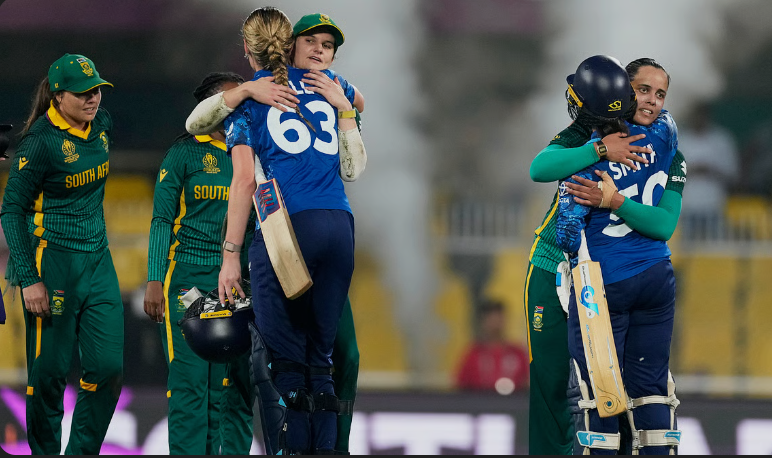
The 2022 World Cup semi-final in Christchurch saw England chase comfortably after restricting South Africa, continuing their hoodoo. Then came 2025 in India: group stage humiliation for South Africa (69 all out, England won by 10 wickets in a 73/0 romp). Revenge arrived in the semi-final at Guwahati—Laura Wolvaardt’s majestic 169 powered South Africa to 319/7, Marizanne Kapp ripped through with 5/20, bowling England out for 194 (125-run win). It was South Africa’s first ODI World Cup final berth, breaking England’s semi-final curse on them.
These matches ignited fan frenzy: English supporters stunned by collapses, Proteas fans erupting in joy over historic breakthroughs. Aggression peaked—fiery spells, verbal volleys, massive momentum swings. Tactics shifted too: South Africa’s batting resilience and all-rounders like Kapp flipped the script against England’s spin-heavy attack.
| Category | Record/Highlight | Player/Detail | Match/Series Context |
|---|---|---|---|
| Highest Individual Score | 169 (143 balls) | Laura Wolvaardt | 2025 Semi-Final, Guwahati – SA’s record WC score |
| Best Bowling Figures | 5/20 | Marizanne Kapp | 2025 Semi-Final – Career-best vs ENG, demolition job |
| Lowest Team Total | 69 all out (20.4 ov) | South Africa Women | 2025 Group Match – ENG spin dominance |
| Biggest Win Margin | 125 runs | South Africa Women | 2025 Semi-Final – Historic upset |
| Notable Chase/Collapse | 194 all out chasing 320 | England (Sciver-Brunt 64 top score) | 2025 Semi – Early top-order crumble |
| Key Partnership | Strong opening stand leading to 319/7 | Wolvaardt & Brits | 2025 Semi – Recovery from early wks |
| Iconic Moment | SA reach maiden WC final | Breaking 3 prior semi losses (2000,2017,2022) | 2025 – Fan emotion explosion |
| England Dominance Flip | From 10-wkt group win to semi thrashing | Full circle revenge | 2025 tournament arc |
T20 Fireworks and Close Calls
The T20 era brought pure fireworks and nail-biting close calls to the England Women’s National Cricket Team vs South Africa Women’s National Cricket Team rivalry. Short-format cricket unleashed aggression: blistering power-hitting, death-over heroics, and high-pressure chases that had fans roaring.
England set the benchmark early with their record-shattering 250/3 in Taunton 2018—the highest women’s T20I total ever at the time—powered by Tammy Beaumont’s explosive 116 off 52 balls. South Africa fought back in thriller mode: tense low-scoring battles like the 2023 T20 World Cup semi-final (SA 164/4 beat ENG 158/8 by 6 runs) showed their growing bite. Recent series delivered edge-of-seat drama—England’s clinical wins mixed with South Africa’s gritty near-misses and rare triumphs, like close-run chases under lights.
Player rivalries intensified: Nat Sciver-Brunt’s all-round fireworks clashed with Marizanne Kapp’s fiery pace and Laura Wolvaardt’s elegant timing. Tactics evolved—England’s explosive top order vs Proteas’ disciplined death bowling. Fan emotions boiled: English crowds celebrated records, while South African supporters erupted over breakthroughs. These T20 clashes turned the rivalry from one-sided to unpredictable thrillers.
| Category | Record/Highlight | Player/Detail | Match/Series Context |
|---|---|---|---|
| Highest Team Total | 250/3 | England Women | Taunton 2018 – World record at time |
| Best Individual Score | 116 (52 balls) | Tammy Beaumont | Taunton 2018 – Explosive century |
| Highest Partnership | Massive opening stand in 250 total | Beaumont & Wyatt combo | Record-breaking powerplay assault |
| Best Bowling Figures | 5/12 | Shabnim Ismail (career best vs ENG) | Key spell in series win |
| Notable Chase | 158/8 falling short by 6 runs | England chasing SA 164/4 | 2023 T20 WC Semi – Tense thriller |
| Close Call Win | SA win by 6 runs | South Africa Women | 2023 Semi-Final – Nail-biter |
| Fastest Scoring Highlight | Rapid fifties in high chases | Sciver-Brunt / Wyatt bursts | Multiple T20 thrillers |
| Iconic Moment | England break T20 world record | 250/3 demolition | 2018 – Fan frenzy, record books |
| Recent Thriller | Tight finishes in bilateral series | Multiple 10-20 run games | 2020s – Rivalry heating up |
The Rivalry Today
The rivalry today stands at its most balanced and intense point ever. South Africa’s breakthrough 2025 World Cup semi-final win—crushing England by 125 runs after Laura Wolvaardt’s 169 and Marizanne Kapp’s 5/20—marked a watershed. It ended England’s semi-final dominance over the Proteas and propelled South Africa to their first final, shifting power dynamics permanently.
As of early 2026, the head-to-head remains England-favored overall (around 36-10 in ODIs historically), but recent clashes show parity. South Africa’s all-round depth, pace attack led by Kapp and Shabnim Ismail, and batting resilience under Wolvaardt challenge England’s experience and spin options like Sophie Ecclestone. England counter with Nat Sciver-Brunt’s unmatched all-round brilliance and tactical nous under Heather Knight.
Fan passion boils over: English supporters demand redemption after 2025 heartbreak, while Proteas fans celebrate the rise from perennial underdogs. Aggression defines every ball—fiery bouncers, verbal spars, massive crowds roaring. Upcoming tours or bilateral series promise fireworks, with both sides hungry. Tactics evolve: South Africa exploit death overs better; England lean on aggressive top-order power.
| Category | Record/Highlight | Player/Detail | Match/Series Context |
|---|---|---|---|
| Current Overall H2H (ODIs) | England lead ~36-10 (approx.) | Historical edge narrowing | Pre-2025 dominance vs recent parity |
| Recent Signature Win | 125-run victory | South Africa Women | 2025 WC Semi – Maiden final berth |
| Highest Recent Score | 319/7 | South Africa (Wolvaardt 169) | 2025 WC Semi – Batting masterclass |
| Best Recent Bowling | 5/20 | Marizanne Kapp | 2025 WC Semi – Career-defining spell |
| Lowest Recent Total | 69 all out | South Africa Women | 2025 WC Group – England spin control |
| Key All-Round Impact | Consistent 50+ & wickets | Nat Sciver-Brunt (ENG) / Kapp (SA) | Defining modern clashes |
| Notable Flip Moment | From 10-wkt group loss to semi revenge | Full tournament arc | 2025 WC – Momentum shift |
| Tactical Edge Today | Pace/death bowling surge | Proteas all-rounders | Challenging England’s spin reliance |
| Fan Emotion Peak | Massive celebrations post-semi win | South African supporters | Breaking hoodoo, global buzz |
| Future Outlook | Balanced, high-intensity battles ahead | Both teams at peak form | Rivalry at boiling point |
Conclusion
Today, this rivalry burns at its brightest: England’s experience meets South Africa’s surging confidence, delivering edge-of-seat thrillers and mutual respect. From early draws to maiden World Cup finals, the journey proves women’s cricket thrives on passion, skill, and evolution. Whatever comes next, these clashes will continue captivating the world—one dramatic ball at a time